
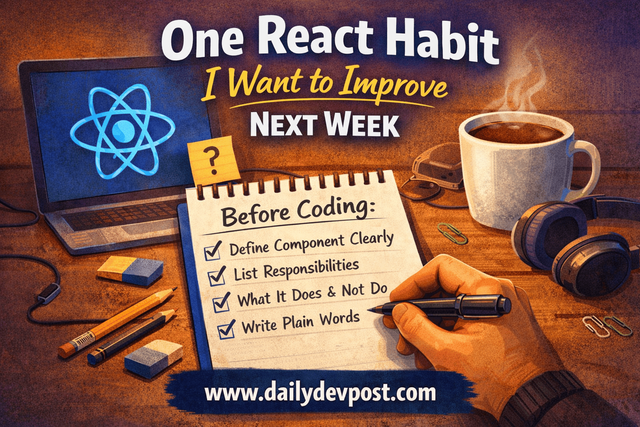
There are many things I could say I want to improve in React.
I could say performance.
I could say architecture.
I could say learning new APIs.
I could say writing fewer bugs.
But none of those are habits.
They are outcomes.
When I think honestly about my React work, the biggest improvements never came from learning a new concept. They came from changing small daily behaviors. Quiet habits that affect how I write code, not what features I know.
So next week, there is one React habit I want to improve.
Not forever.
Not perfectly.
Just next week.
That habit is this:
Before writing code, I want to slow down and clearly describe what the component actually does in plain words.
No JSX.
No hooks.
No logic.
Just words.
It sounds simple.
Almost too simple.
But this habit is something I repeatedly skip and it shows up later as confusion, re-renders, tangled props, and components that feel “heavy” for no clear reason.
This post is about why this habit matters, how I currently fail at it and how I want to practice it next week.
How I Usually Start Writing React Components
Most of the time, my workflow looks like this:
- I get a requirement
- I already have a picture of the UI in my head
- I open the file
- I start typing JSX
- I add state
- I add effects
- I pass props
- I adjust things until it works
At no point do I stop and ask:
“What is this component’s responsibility, exactly?”
Not vaguely.
Not mentally.
But clearly.
Because in my head, it feels obvious.
But obvious in the head is often unclear in code.
I’ve noticed that when I skip this thinking step, I tend to:
- Add state “just in case”
- Pass too many props
- Mix UI logic and data logic
- Put side effects where they don’t belong
- Keep refactoring the same component again and again
Nothing breaks.
The app works.
But the code feels harder than it should be.
The Habit I Want to Build (Very Specifically)
The habit is not:
- “Think more”
- “Design better”
- “Write clean code”
Those are too abstract.
The habit I want to build is this:
Before writing any React code, write 3–5 plain English sentences describing what the component does and does NOT do.
That’s it.
No diagrams.
No documentation.
No long notes.
Just a short description like:
- What this component is responsible for
- What decisions it makes
- What decisions it does not make
- What data it needs
- What it shows when things go wrong
If I can’t explain that clearly, I’m not ready to write the component.
Why This Habit Matters More Than It Sounds
React itself is not the hard part anymore.
JSX is simple.
Hooks are familiar.
Most bugs are not syntax problems.
The real difficulty comes from unclear responsibility.**
When a component does too many things, everything becomes harder:
- Testing feels painful
- Re-renders become unpredictable
- Props feel confusing
- Small changes cause unexpected issues
All of this often traces back to one root cause:
I didn’t decide what the component was responsible for before I wrote it.
By forcing myself to describe the component in words first, I’m forced to make decisions early when changes are cheap.
A Real Example From My Own Code
Let me give a very common example.
Imagine a UserProfile component.
In my usual flow, I might:
- Fetch user data inside it
- Handle loading state
- Handle error state
- Render user details
- Handle edit mode
- Handle save action
- Show success messages
All inside one component.
It works.
But over time, it becomes messy.
Now imagine I stop and write this before coding:
“This component is responsible for displaying user profile information.
It does not fetch data.
It does not handle saving.
It only receives user data and display state as props.
It shows loading and error states based on input, not internal logic.”
Suddenly, many decisions are made for me.
- Fetching moves outside
- Saving moves outside
- The component becomes predictable
- Props become clearer
- Re-renders are easier to reason about
The code becomes simpler not because I used a new pattern, but because I clarified responsibility early.
Why I Skip This Habit (If I’m Honest)
I don’t skip this habit because I don’t know it’s useful.
I skip it because:
- It feels slow
- It feels unnecessary for “small components”
- I’m eager to see something on the screen
- Writing words feels less productive than writing code
There’s also a quiet confidence trap.
I think:
“I already know what this component does.”
But knowing something in your head and expressing it clearly are not the same thing.
If I can’t explain a component simply, I usually don’t understand it as well as I think.
How This Habit Helps With Other React Problems
What I like about this habit is that it indirectly improves many other areas.
1. Better State Placement
When I describe responsibilities clearly, it becomes obvious:
- Which state belongs here
- Which state should live higher
- Which state doesn’t belong at all
I stop adding state by instinct.
2. Cleaner Props
When a component has a clear job, props become easier to name and limit.
I stop passing “just one more prop” because the description already sets boundaries.
3. Fewer Effects
Many unnecessary useEffect hooks come from unclear responsibilities.
When the component’s job is clear, effects either clearly belong or clearly don’t.
4. Easier Refactoring
When I come back to the code weeks later, that original description acts like a mental anchor.
I remember what the component was supposed to do not what it accidentally grew into.
How I Want to Practice This Next Week
I’m not trying to change everything at once.
Next week, my rules are simple:
- I will do this for new components only
- I will write the description as comments at the top of the file
- I will not overthink the wording
- I will allow myself to adjust the description if needed
Even something like this is enough:
This component displays a list of posts.
It does not fetch data.
It receives posts and loading state as props.
It handles empty states.
It does not manage pagination logic.
That’s it.
No perfection.
No documentation pressure.
Just clarity.
What I Expect to Feel (And Accept)
I expect a few things to happen:
- I’ll feel slightly slower at first
- I’ll feel tempted to skip it
- I’ll think “this is obvious” sometimes
And that’s okay.
This habit is not about speed.
It’s about reducing future friction.
I’ve learned that most React pain doesn’t come from today’s code.
It comes from code written weeks ago without clear intent.
Why I’m Writing This Publicly
I’m writing this not because I’ve mastered this habit.
I haven’t.
I’m writing it because naming the habit makes it real.
When I say “I want to improve React,” nothing changes.
When I say “I want to describe component responsibility before coding,” I know exactly what to do tomorrow.
This also fits how I want to learn and write:
- Slowly
- Honestly
- Without pretending I have it all figured out
Final Thought
If I improve only one React habit next week, I want it to be this one.
Not learning something new.
Not optimizing prematurely.
Not chasing patterns.
Just slowing down enough to ask:
“What is this component actually responsible for?”
And answering that in simple words before touching the keyboard.
That small pause might save hours later.
And more importantly, it might make my React code feel lighter, calmer and easier to live with.
That’s a habit worth practicing.
☕Did you like the article? Support me on Ko-Fi!