Nothing is broken.
The app loads.
The button works.
The API responds.
Tests pass.
You still open the file.
Just to check something.
Within seconds, you slow down.
You reread a line.
Then another.
You scroll up to find where a value came from.
You follow a variable across the file like it might disappear.
The logic is simple.
Still, reading the code feels tiring.
That quiet friction is the problem this article is about.
Not bugs.
Not performance.
Not architecture.
Naming in frontend code.
If the logic is correct, why does this still feel hard to read?
Logic answers one question:
What happens?
Naming answers a different one:
What is this thing supposed to represent?
When naming is weak, your brain fills the gaps.
You are no longer reading.
You are interpreting.
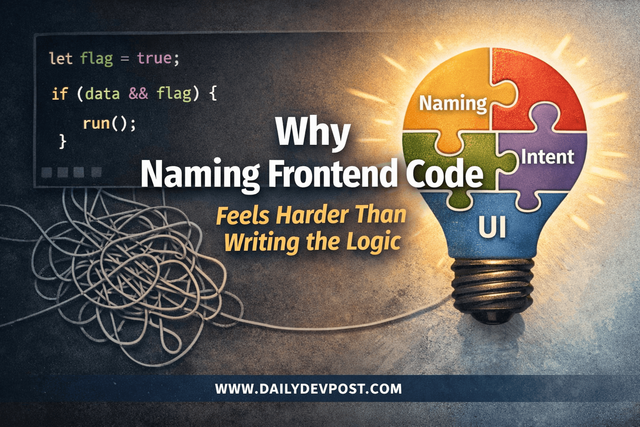
Consider this line:
if (data && flag) {
  run()
}
There is no complex logic here.
Yet questions appear immediately.
What is data?
Why does it matter here?
What does flag stand for?
What does run actually do?
The code works.
Understanding does not come for free.
This is why frontend code readability breaks down even when logic is correct.
Bad names force your brain to simulate behavior instead of recognizing intent.
That simulation is exhausting.
Why do I struggle to name things I clearly understand?
Because you don’t understand them in the way naming requires.
You understand them locally.
Naming requires global clarity.
When writing logic, step-by-step understanding is enough.
- Get a value
- Check a condition
- Call a function
That produces working code.
Naming asks something harder:
What role does this thing play in the system as a whole?
Early on, that answer is unclear.
You may know:
- What the variable holds right now
- What the function does today
You often don’t yet know:
- How long it will exist
- How many components will depend on it
- How its meaning will shift as features grow
So naming feels heavy.
Not because you are bad at it.
Because you are being honest about uncertainty.
Why is frontend naming harder than backend naming?
Backend code mostly names data.
Frontend code names intent, state and user perception.
That difference changes everything.
On the backend, user usually means one thing.
On the frontend, user might be:
- A logged-in account
- A partial profile
- Cached data
- A loading placeholder
- An optimistic update
Same name.
Different meanings.
Different moments.
Frontend code lives at the intersection of:
- Changing designs
- Evolving requirements
- Human interaction
- Visual state
You are not naming values.
You are naming situations.
That is why naming in frontend code feels unstable.
The ground keeps shifting.
Why do boolean names cause so much confusion?
Because booleans hide complexity.
True or false looks simple.
Meaning rarely is.
if (!isReady) {
  return
}
To understand this, your brain does extra work.
What does “ready” mean here?
Ready for what?
Is this loading? Invalid? Disabled? Missing data?
The boolean forces interpretation.
Frontend code is full of temporary states:
- Loading
- Empty
- Partial
- Submitting
- Saving
- Error
- Success
Flattening these states into booleans removes context.
The logic remains correct.
Readability suffers.
This is why variable naming in JavaScript feels harder in UI code than in pure logic.
Why does refactoring logic feel easier than renaming?
Logic refactors are mechanical.
You can:
- Extract a function
- Inline a value
- Add a guard
- Change control flow
Renaming is not mechanical.
Renaming forces questions:
- What is this really responsible for now?
- Has its meaning changed?
- Am I hiding design drift behind an old name?
Many naming problems are design problems waiting to be acknowledged.
Renaming brings them to the surface.
So we postpone it.
And live with the friction.
Why does my frontend code work but still feel heavy?
Because your brain is doing runtime work.
When names are unclear, you can’t trust the surface.
You read deeper than necessary.
You jump between files.
You recheck conditions.
You verify assumptions.
Nothing here shows up in metrics.
It shows up as fatigue.
Clear naming reduces reading cost.
Poor naming increases it silently.
How do bad names slow down debugging without causing bugs?
Most debugging time is spent finding, not fixing.
Bad names slow the search.
You assume meaning.
You debug in the wrong direction.
Later, you learn the name lied.
Bad naming doesn’t break the app.
It breaks momentum.
When should I rename instead of rewriting logic?
Rename when reading feels harder than writing.
Signals:
- You rename things in your head
- You add comments to explain names
- You hesitate before explaining a function
- The name reflects the past, not the present
Renaming is not cleanup.
It is clarification.
If a rename makes the code feel lighter, it did real work.
Why does naming feel more like writing than programming?
Because it is writing.
Logic speaks to machines.
Names speak to humans.
Good naming feels like editing:
- Removing extra words
- Choosing precise meaning
- Avoiding clever shortcuts
- Favoring clarity
You are not solving a problem.
You are explaining one.
That takes effort.
How do experienced developers actually choose names?
They don’t wait for perfect clarity.
They choose names that match current understanding.
Then they revisit them.
Experienced developers rename freely.
They don’t treat early names as permanent.
Understanding improves.
Names should follow.
Why does naming get easier with experience?
Because experience changes how you think.
You stop naming after:
- Data shape
- Implementation detail
- Temporary structure
You start naming after:
- Intent
- Responsibility
- Mental model
That shift comes from reading your own code months later.
A quiet takeaway
The code was never hard.
Understanding it was.
When naming frontend code feels harder than writing logic, it means you care about clarity, not just correctness.
That friction is not a flaw.
It is a signal.
If a small rename makes your code easier to read tomorrow,
you did meaningful work today.
Nothing flashy.
Nothing broken.
Just less effort for the next person who opens the file.
Often, that person is you.
(If you want to fix this, I wrote about one habit that made my code easier to read).
☕Did you like the article? Support me on Ko-Fi!