
- Thumbnail
[!TIP]
🌐 Edge Intelligence: The Senior Architect's TL;DR
- The Cold Start Tax: Traffic at the Edge is spread thin. Expect more frequent, though smaller, initialization delays.
- Isolates > Containers: V8 Isolates boot in
<5ms>, whereas Docker containers take seconds. This is the foundation of 2026 performance.- Data Locality: If your data is in Virginia and your code is in Singapore, you haven't fixed latency; you've just moved the waiting room.
- Micro-Edge Strategy: Break monolithic functions into tiny, single-purpose Isolates (
<50KB) to ensure sub-10ms execution.
I used to think that moving our API logic to the Edge would solve all our latency problems. "Put the code near the user," the marketing said. "Zero latency," they promised. "Instant global scale."
What are Edge Cold Starts?
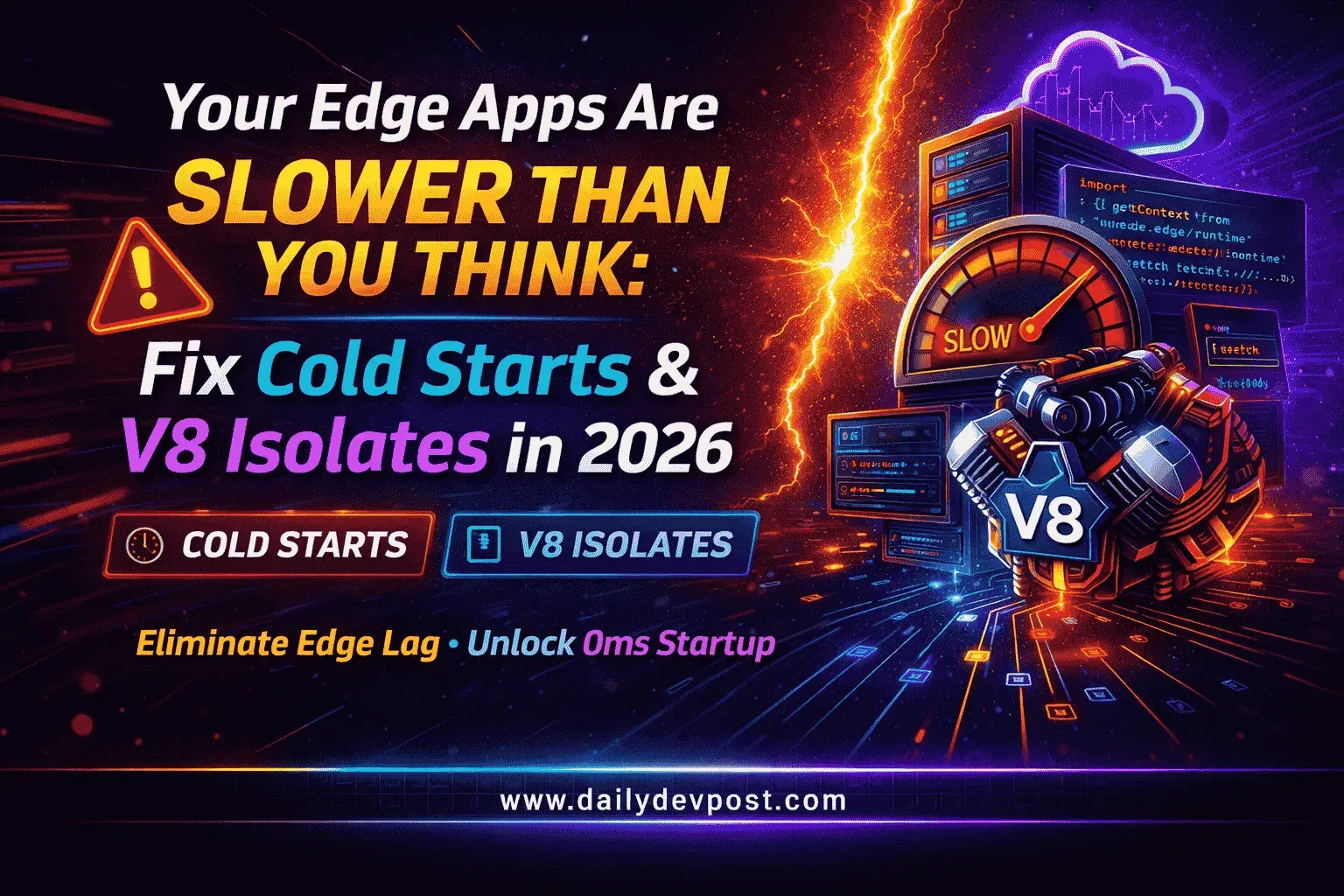
Edge Cold Starts are initialization delays that occur when a cloud provider spins up a new instance of an Edge function (a V8 Isolate) to handle a user request. In 2026, these are minimized by using Isolate-native frameworks like Hono and keeping bundle sizes sub-50KB to ensure sub-10ms startup times.
So, I moved a heavy Node.js authentication middleware to a popular Edge provider. The result? Our P99 latency didn't drop. It tripled. For some users in Europe, the site felt slower than when we were hosting everything in a single AWS region in Northern Virginia.
In 2026, we’ve moved past the "Edge hype" and into the "Edge reality." If you want to build high-performance, server-first apps as outlined in my 2026 Frontend Roadmap, you have to understand the physical constraints of Edge computing cold starts.
This understanding is also a core requirement for mastering frontend system design interviews in the modern era.
The Cold Start Trap: A Real-World Metric for 2026
A "cold start" happens when your cloud provider has to spin up a new instance of your function to handle a request. At the Edge, this problem becomes more frequent because your traffic is spread across hundreds of tiny data centers (Points of Presence) instead of one large one.
If you have 100 users spread across 100 cities, every single one of them might trigger a cold start. I’ve seen teams lose all their gains from the React Compiler because their Edge function latency was spiked by a 300ms initialization tax.
Runtime Constraints: V8 Isolates vs. Docker
To solve this, major Edge providers in 2026 have moved toward V8 Isolates. This is a fundamental shift in infrastructure. An Isolate is a lightweight execution context within a single V8 process - the same technology that keeps your browser tabs separate.
| Feature | V8 Isolates (Modern) | Docker Containers (Legacy) |
|---|---|---|
| Cold Start | <5ms | 200ms - 2000ms |
| Memory Footprint | ~10KB - 1MB | 50MB - 500MB |
| Scaling | Instant (Isolate spin-up) | Slow (Orchestration) |
| Context | Shared Process | Virtual OS |
| Ideal For | Edge logic, Middleware | Heavy background tasks |
The Precision of V8 Isolates
In 2026, we treat every byte of our Edge bundle as a performance regression. If a library doesn't run in a standard Web Worker environment, it doesn't belong at the Edge.
The Data Locality Paradox
This is the biggest mistake I see in senior-level interviews. You move your code to an Edge node in Singapore, but your database is still in Virginia. One DB query across the ocean takes 200ms, completely negating the 5ms proximity of the Edge server.
In 2026, we solve this with Edge Regions and Global Caching using tools like Cloudflare KV or Upstash. If your database isn't distributed, your Edge logic is just a faster way to wait for a slow network.
Architectural Pattern: The "Hono" Micro-Edge Strategy
On my team, we refactored our monolithic Edge middleware using the Micro-Edge Pattern:
- Framework Choice: We shifted to Hono for its ultra-fast, Isolate-compatible runtime performance.
- Logic Separation: Localization runs on every request; heavy analytics runs asynchronously using
ctx.waitUntil(). - Pre-Warm Strategy: We "ping" critical nodes once a minute to keep Isolates warm and eliminate the cold start tax.
The result? Our average Edge execution time dropped from 150ms to 12ms.
Resumability and Streaming at the Edge
Frameworks that use Resumability can stream serialized state from the Edge node directly to the user. Instead of the Origin server rendering the whole page, it sends a skeleton to the Edge, which "stitches in" user-specific data from local Edge Config.
This is the "Holy Grail" of serverless edge constraints 2026. The user gets a fully rendered, personalized page in sub-50ms. I detail this shift in my post on Edge vs. Origin.
Conclusion: Engineering over Magic
The Edge is a powerful tool, but it’s not a substitute for discipline. In 2026, the best architects are the ones who treat the network as a physical constraint.
Respect the physics, measure your cold starts, and keep your runtime lean. When you understand the "why," the "how" becomes the easy part. I’ll see you at the network’s edge.
[!TIP] Understanding the physics of the edge is a core pillar of our Frontend Development Roadmap 2026. For more on architectural trade-offs, check out our Logic Placement Guide.
Frequently Asked Questions
What are the common causes of high Cold Start times at the Edge?
Memory-intensive bundles and large NPM dependencies are the most common culprits. If your function exceeds 1MB, the V8 Isolate must spend significant time parsing and initializing the execution context.
How can I minimize Cold Starts for my Edge functions?
Keep your bundle size under 50KB, avoid heavy NPM dependencies, and use Isolate-native frameworks like Hono. Additionally, implementing a 'Pre-Warm' strategy by pinging your function periodically can keep it active.
Can I use any NPM package at the Edge?
No. Many packages rely on Node.js internals (like 'fs' or 'net') that are unavailable in V8 Isolate runtimes. Stick to packages that use standard Web APIs or are specifically optimized for the Edge.
How does the Edge improve Interaction to Next Paint (INP)?
By processing business logic like A/B testing and localized redirects at the Edge, you reduce the time it takes for the browser to receive and respond to the first byte, directly improving the overall interactivity score.
Related Articles
![Illustration of Frontend Engineering, Software Architecture, Web Performance Optimization concepts for: Advanced TypeScript 2026: Build scalable server-first apps with resumability, branded types and type-safe routing [complete guide]](/_next/image?url=https%3A%2F%2Fik.imagekit.io%2Fbqu15hkfo%2Ffrontend-engineering%2Fadvanced-typescript-2026-server-first-resumability-guide.png&w=3840&q=75)
Published By

Pradip Jarhad
I’m Pradip. Software Developer and the voice behind DailyDevPost. I translate daily development struggles into actionable lessons on React, Next.js, JavaScript and deep dive debugging. Built for the craftsman developer who values real world logic over theory. Stop building software and start engineering it.
☕Did you like the article? Support me on Ko-Fi!